
Engineer your risk.
Don't run into it.
A qualified, correlation-aware portfolio of EAs survives what any single strategy cannot. PortQuant qualifies each strategy, builds the portfolio against your risk budget, validates the combined curve with Monte Carlo, deploys it with a local guardrail — then watches every strategy against the expectations PE just set.
Invitation only — request access and we'll reach out with next steps.
Includes everything in Exposure & Risk Control — live equity drawdown, per-strategy attribution, account-level rules, Telegram alerts, customizable dashboards, mobile. The construction layer sits on top.
One EA is a bet. A portfolio is a system.
A single EA — even a profitable one — concentrates regime risk, correlation risk, and parameter risk into one system. When the market behavior it was tuned for shifts, you have no buffer.
A portfolio of qualified, low-correlation EAs distributes those risks. When one strategy hits its worst quarter, others are usually doing fine. The combined equity curve is smoother, the maximum drawdown lower, and the recovery faster than any single component.
Building one isn't optional anymore. It's the difference between trading and gambling on a single tuning.
The technical foundation
Every PE step runs on minute-level real equity drawdown.
The standard approach to backtest analysis reads MT5 reports as closed-trade sequences — balance only, no view inside an open position. That's how "profitable" strategies hide six-week floating losses, and how grid and martingale runs look like calm slopes when they're actually carrying 10x the disclosed risk.
PortQuant downloads the M1 candles for the project window and reconstructs the per-minute equity curve trade by trade. Every later step — qualification, Monte Carlo, correlation, allocation, validation — runs on the real equity profile, not the broker's closed-trade story. Including the floating drawdowns standard tools never sample.
Without this, the strategy whose backtest "looked profitable" but at one point sat at −42% equity for twelve days has somewhere to hide. With it, it doesn't.
The lifecycle
Seven stages. One closed loop.
Scope the project. Upload your backtests. Qualify each strategy. Build the portfolio. Validate the combined curve. Deploy with a guardrail. Monitor the drift back to refinement. That's the process.
1 · Scope it
Define the project. Lock the data.
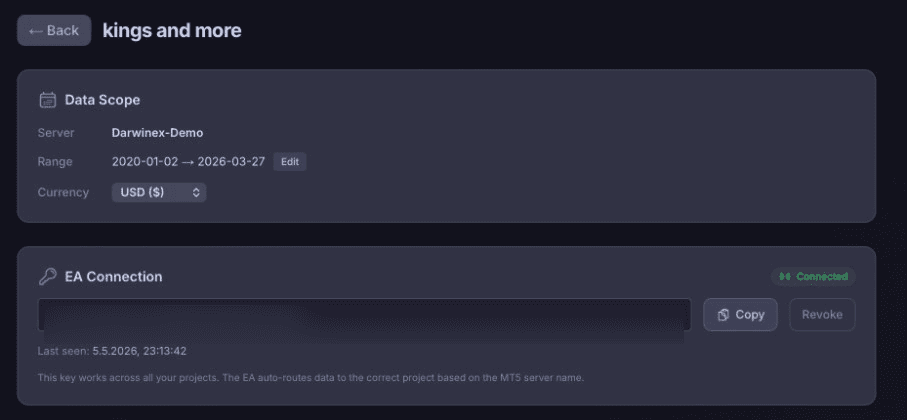
- A project is scoped by broker, date range and base currency. Every later stage runs against this exact ground truth — not a vague "I tested on EURUSD".
- The PE Data EA pulls M1 candles directly from your MT5 terminal — no hunting through MQL5 forums for missing months of data. One key works across every project; data auto-routes by MT5 server name.
- Coverage check confirms the broker's actual bar count before qualification runs. If your broker is missing data, you find out before any optimizer wastes a cycle.
2 · Upload backtests
Drop in your MT5 strategy tester reports.
- Multi-strategy ingest. Upload `.xlsx` or `.html` reports straight from MT5; PortQuant parses magic numbers, instruments and parameters automatically. Variant labels supported for testing the same EA under different settings.
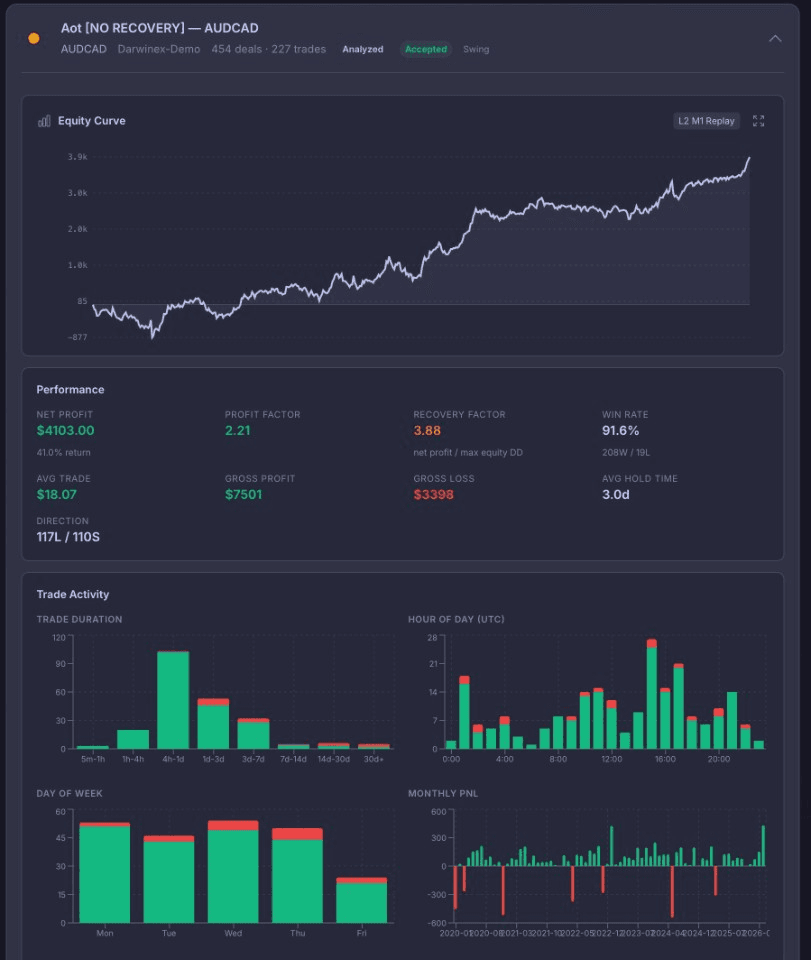
- TME reconstruction builds a minute-level equity timeline trade by trade — Equity Curve, Performance block (net profit, profit factor, recovery factor, win rate, average hold time, long/short split) all derived from the reconstructed M1-resolution timeline, not the broker's closed-trade summary.
- Per-strategy distributions auto-generated: Trade Duration buckets, Hour-of-Day (UTC), Day-of-Week, Monthly P&L. The full behavior profile before you allocate a single cent.
3 · Qualify
Tier each strategy on robustness, not just return.
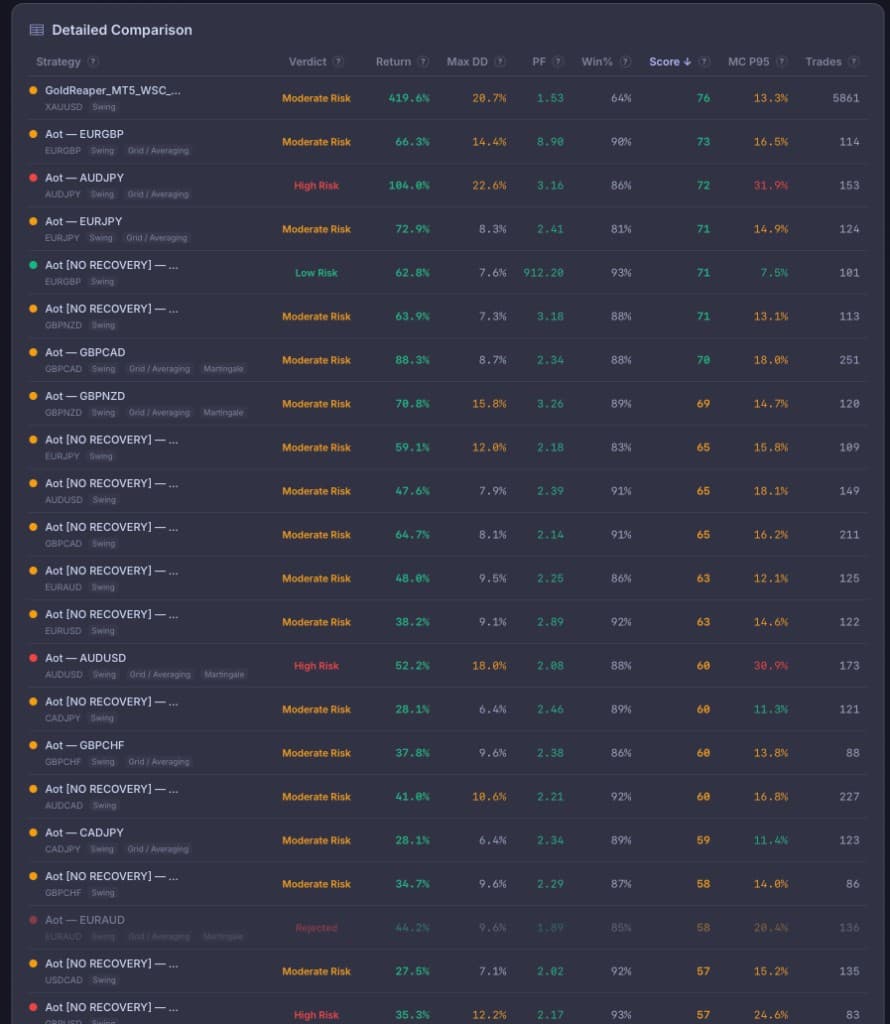
- Quality Score out of 100, broken into Return / Risk / Robustness components — so a 72-point strategy with 85 robustness and 37 return is read differently from a 72-point strategy with the opposite split.
- Robustness tests every strategy is graded against: trade count floor, profit concentration cap, temporal consistency (1st-half vs 2nd-half profit factor), cost stress (+1 / +2 pip), bootstrap edge stability (1,000 iterations), and margin analysis that flags grid / Martingale strategies consuming 3–24× the backtest margin in concurrent positions.
- Per-strategy Monte Carlo (5,000 paths) running on both Balance and Equity — not just closed-trade returns the way standard MC does. Grid and martingale strategies are isolated during simulation so their concurrent open positions don't distort the result. Full Confidence Levels P50 → P100 on Balance DD, Equity DD, Net Profit and Return; Risk-of-Ruin by capital at every tier.
- Verdict per strategy: Low Risk / Moderate Risk / High Risk / Rejected. The portfolio builder reads from the qualified set only — Rejected strategies don't sneak in. Strategy badges surface the structural risks: Swing, Grid / Averaging, Martingale.
4 · Build
Correlation-clustered. Capped. Sized to your risk budget.
- Daily-return correlation matrix across every pair of qualified strategies. Diversification verdict (e.g. "Moderate diversification · avg 0.20 · 51 of 406 pairs above 0.5") plus the highest-corr pair and worst concurrent-DD pairs surfaced explicitly — no hunting for the bad clusters yourself.
- You set the constraints once: account capital, max portfolio DD%, max strategies per symbol, max underwater days, max correlation. PortQuant tunes allocation weights and grid / martingale concentration per project from your own backtest data — no manual lever-pulling.
- Walk-forward proven against exhaustive optimization (which overfits): assembly runs in seconds, beats the optimizer out-of-sample. Honest about what works in practice — see the Monte Carlo article in Resources.
- Excluded strategies are listed with reasons — Grid / MG cap reached, correlation dedup, underwater-days breach — so it's never a black box.
![PortQuant Portfolio Engineering Interaction Analysis — Daily Return Correlation matrix across the qualified strategies, with a Moderate diversification banner (avg correlation 0.20, 51 of 406 pairs above 0.5), the Highest-corr pair (Aot [NO RECOVERY] — CADJPY ↔ Aot — CADJPY at 0.99), and the Worst concurrent-DD pairs called out (NZDCAD pair 61%, NZDCAD pair 50%, EURCAD pair 43%). Heatmap cells coded Negative / Low / Moderate / High.](/_next/image?url=%2Fmarketing%2Fpe%2F04-build-correlation-matrix.png&w=3840&q=75)
5 · Validate
The portfolio as one system — Calmar, Sharpe, max DD, the lot.
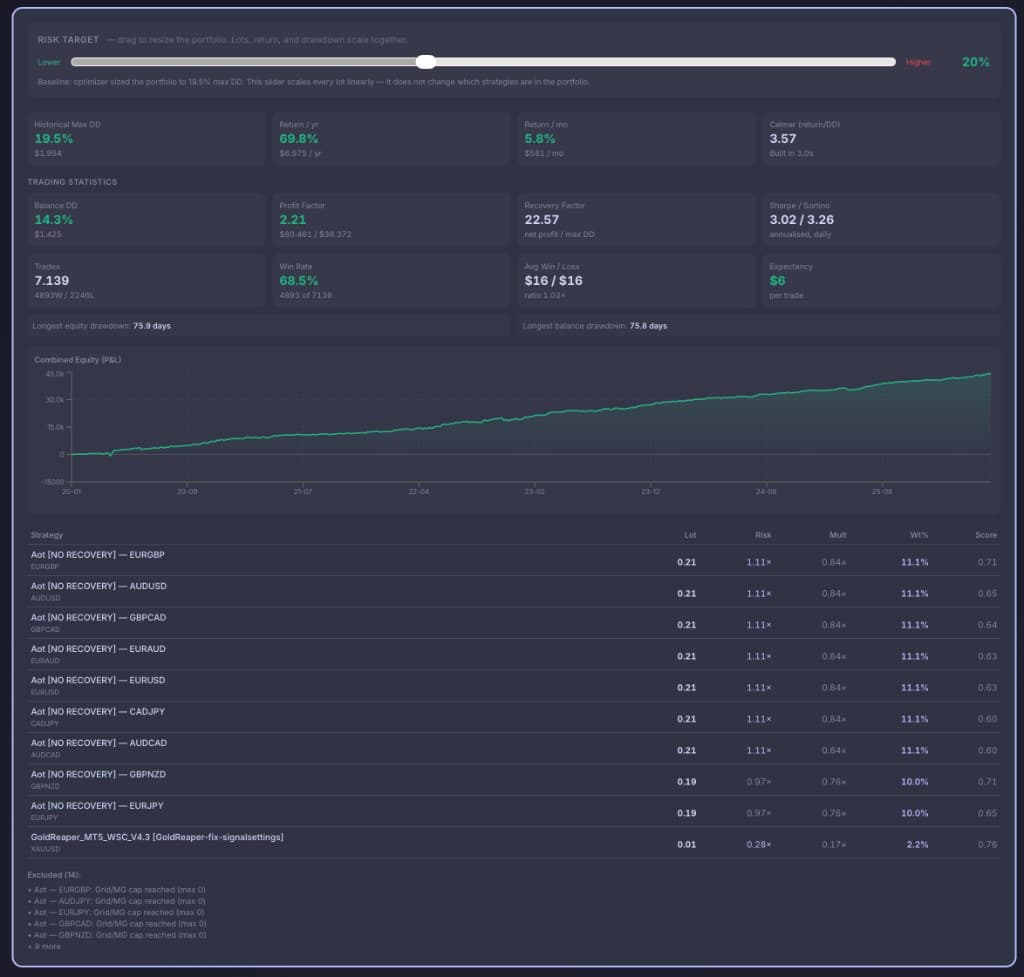
- Combined equity (P&L) curve for the assembled portfolio across the full project window. Historical max DD, return per year and per month, Calmar (return/DD), Sharpe and Sortino — the portfolio scored as a single system, not a stack of individual strategies.
- Trading statistics carry the full reality: balance DD vs equity DD, profit factor, recovery factor, trade count, win rate, average win/loss ratio, expectancy per trade, longest equity drawdown vs longest balance drawdown.
- A live risk-target slider rescales every lot linearly without re-running the optimizer — drag once to see what the portfolio looks like at 15% max DD vs 25%, without changing which strategies are in it.
- Per-strategy allocation table: lot size, risk multiplier, weight%, score. Excluded strategies listed with reasons. Combined-curve Monte Carlo on the assembled portfolio uses the same Balance + Equity / grid-aware engine as the per-strategy stage — the same rigor scaled to the portfolio.
6 · Deploy
Calibrated lots. Local guardrail. Live.
- Portfolio output: per-strategy magic + lot calibrated to the risk budget you set. Copy-paste ready into your terminal.
- Aegis Portfolio EA (bundled, MT5) runs locally and auto-flattens positions when configured thresholds are breached — the enforcement layer Risk Control alerts can't deliver alone.
- Aegis license is user-scoped: the same key works across every terminal you run, no per-account re-licensing.
Deployment summary · calibrated lots + Aegis license panel
7 · Monitor & refine
Live performance vs PE expectations. The loop closes here.
- Account-level monitoring is live today (Risk Control). Strategy-level monitoring against PE's projected curves is rolling out — the database is wired, the deployment bridge ships next.
- Telegram alerts on every breach and every clear. Webhooks for Slack, Discord, and custom endpoints — alerting on the same system that built the portfolio.
- When a strategy drifts materially from its PE-projected equity curve, it re-enters the qualification pipeline. The data is different now — so the qualification has to be too.
Strategy-level monitoring · expectation vs reality + drift alert
Step 7 feeds Step 3. Strategies that drift from PE expectations re-enter the qualification pipeline — the regime has changed, so the qualification has to change with it. Engineering a portfolio isn't a one-shot; it's a system you keep current.
What's bundled
Construction layer on top. Risk Control underneath.
Portfolio Engineering includes everything in Exposure & Risk Control — live equity drawdown, per-account drill-down, per-strategy attribution, the trade ledger, account-level rules, Telegram alerts, customizable dashboards and mobile. The construction and deployment pipeline sits on top.
Two pieces unlock at this tier specifically:
- Aegis Portfolio EA — local auto-flatten guardrail (MT5). Runs in your terminal under thresholds you set; license works across every terminal you operate.
- Webhook alerting for Slack, Discord and custom endpoints — in addition to Telegram. Strategy- and portfolio-level coverage as the monitoring bridge ships.
If you only want the simpler standalone enforcement EA without the construction pipeline, Aegis Account Protector is on MQL5 today.
Resources
Read more on portfolio construction.
Monte Carlo Simulation for Forex Risk Analysis
Standard Monte Carlo misses floating drawdowns and breaks on grid strategies. How PortQuant's equity-aware simulation reveals the risk others hide.
Read articleArticleEquity Drawdown vs Balance Drawdown: What MT4/MT5 Traders Miss
Why the curve your broker shows you isn't the curve your account actually went through — and why every PE validation step is built on equity, not balance.
Read articleArticleWhat Is Maximum Adverse Excursion in Forex Trading?
MAE measures the worst drawdown during an open trade — a key qualification signal alongside Sharpe, recovery factor and bootstrap stability.
Read articleCommon questions
What does Portfolio Engineering need from me to start?
A set of MT5 Strategy Tester reports (.xlsx or .html) for the strategies you want to combine, plus M1 candle data for the project window. The bundled PE Data EA pulls the M1 data directly from your MT5 terminal — no third-party feeds. PE handles every reconstruction step, qualification, allocation and validation from there.
How is PE's Monte Carlo different from a standard simulator?
Standard MC reshuffles closed-trade returns and simulates a balance curve only. PE runs on the reconstructed minute-level equity curve, isolates grid and martingale strategies so their concurrent positions do not distort the result, and reports Confidence Levels P50–P100 on Balance DD, Equity DD, Net Profit and Return — plus Risk-of-Ruin tiered by capital. Output is what the account actually went through across 5,000 paths, not a smoothed approximation.
Does the Aegis Portfolio EA close my positions automatically?
Yes. Aegis is a deterministic local guardrail running inside MetaTrader. When a configured threshold is breached (per-strategy or portfolio-level max DD), it auto-flattens positions on the affected magics. Execution is local; PortQuant servers never send trade commands to your terminal. The Aegis license is user-scoped, so one key works across every terminal you run.
Does PE work with my broker?
PE works with any broker that lets you run MT4/MT5 and produce Strategy Tester reports. Data routing inside PE is keyed by MT5 server name, so a single license covers every project across every broker you trade with — no per-broker setup.
Engineer the portfolio before you deploy it.
Portfolio Engineering is invitation only. Request access to be considered for the current cohort — we'll reach out with next steps.